
Task :
Build Sales Funnel Pages for Your Business
Most businesses have a website. Far fewer have a website that is actually designed to convert visitors into leads or customers.
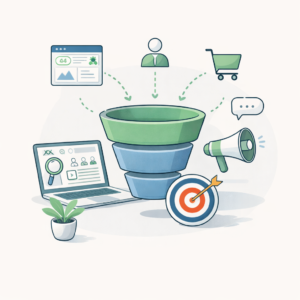
A sales funnel is a set of connected pages that guide a specific visitor — someone who arrived with a specific intent — through a deliberate sequence: from first awareness to a completed action. When these pages are built correctly, they remove the friction that causes visitors to leave without doing anything. When they are missing, your traffic lands on a general homepage and wanders.
Building sales funnel pages is the process of designing and publishing those connected pages — the landing page, the thank you page, and any intermediate steps — so that each part of your marketing has a focused destination that does one job well.
Estimated Cost: €600 – €1,200
Estimated Time Required: 7 – 10 business days
If you are driving traffic through ads, email, or social media but not seeing the enquiries or sales to match, the issue is often the pages people land on — not the traffic itself.
What Exactly is a Sales Funnel Page?
A sales funnel page is a standalone webpage built for a single purpose: to move a specific type of visitor towards one defined action.
Unlike a homepage — which introduces your business to a broad audience and links to many different areas — a funnel page removes all distractions. There is no navigation bar pulling people away, no unrelated content to click through, and no ambiguity about what the visitor is supposed to do next.
A complete funnel typically includes three pages working together.
The landing page is where a visitor arrives after clicking an ad, an email link, or a social post. It presents a specific offer or message — matched to whatever brought them there — and guides them towards one action, such as filling in a form, booking a call, or making a purchase.
The bridge or upsell page is an optional middle step used to confirm the visitor’s action, introduce additional context, or present a secondary offer while attention is high.
The thank you page is where the visitor arrives after completing the action. It confirms what happens next, sets expectations, and can be used to encourage a second action such as booking a call, joining a mailing list, or sharing the offer.
Each page has one job. Together, they form a controlled path that gives you far more influence over what a visitor does than a general website ever can.
How a Sales Funnel Is Built
Step 1 — The goal of the funnel is confirmed: what action should the visitor take, and what does success look like? This determines the structure and content of every page that follows.
Step 2 — The audience and traffic source are reviewed. A funnel page built for cold traffic from a Google ad looks different from one built for warm leads coming from an email. The messaging, offer, and page length are matched to where the visitor is coming from.
Step 3 — Each page is written with a clear hierarchy: headline, supporting copy, social proof, and a single call to action. No page includes content that serves a different goal.
Step 4 — The pages are designed and built — either within your existing website platform or in a dedicated funnel tool — and connected in sequence so the visitor moves from one step to the next without friction.
Step 5 — Forms, tracking, and confirmation flows are configured so that every lead submission is captured correctly and triggers the appropriate follow-up.
Step 6 — The funnel is tested end to end before going live to confirm that every step works, tracking is in place, and the visitor experience is exactly as intended.
Why Funnel Pages Improve Results
Traffic on its own has no value. What matters is what that traffic does when it arrives.
A general website is designed to inform — to give a visitor enough information about your business that they might decide to get in touch. A funnel page is designed to convert — to take a visitor who already has a specific intent and guide them towards completing one action as efficiently as possible.
When businesses run ads or email campaigns that point to a general homepage, they introduce a mismatch. The visitor arrived because something specific caught their attention. The homepage gives them something general. The disconnect causes most visitors to leave without taking any action at all.
Funnel pages close that gap. Because the message on the page matches the message that brought the visitor there, the visitor feels they are in the right place. Because the page has one call to action rather than many, the next step is obvious. And because distractions have been removed, the visitor’s attention stays where it belongs.
The result is a higher conversion rate from the same amount of traffic — which means more leads and sales without increasing what you spend.
Why Most Business Websites Were Not Designed to Convert
Most business websites are built to explain what a business does. They are structured around the business — the services page, the about page, the contact page — rather than around a visitor who has arrived with a specific question or need.
This works for visitors who are already familiar with your business and want to learn more. It works poorly for visitors who arrived from an ad or a campaign, because those visitors came with a specific intent that your general website structure was never designed to address.
There is also the issue of choice. A homepage with eight navigation options gives a visitor eight decisions to make before they take any action. Most will make none of them. A funnel page with one clear call to action gives the visitor one decision. That single change — removing the alternatives — consistently improves conversion rates across almost every type of business.
The other common issue is message mismatch. An ad that promises a specific offer or outcome should lead to a page that immediately delivers on that promise. When the visitor lands on a homepage instead, the connection is broken. They spend time searching for the thing they were expecting to find — and most stop looking before they find it.
Sales funnel pages are built specifically to fix these problems. They are designed around the visitor, not the business.
What We Will Do When Building Your Sales Funnel Pages
- Review your existing marketing campaigns and identify where visitors are currently landing
- Confirm the goal of the funnel and the single action each page should drive
- Write the copy for each page — headline, supporting paragraphs, proof points, and call to action
- Design and build the landing page, thank you page, and any intermediate steps required
- Set up and configure the lead capture form, including confirmation and notification flows
- Connect tracking so every submission and page visit is recorded correctly in your analytics
- Test the full funnel end to end before publishing to confirm every step functions as intended
- Provide a summary of the funnel structure, what each page does, and how to monitor performance
You Need Sales Funnel Pages When
- You are running paid ads that send visitors to your homepage rather than a dedicated page
- Your ads or campaigns are generating traffic but not enough enquiries or sales
- You are promoting a specific offer, product, or service and need a focused destination for it
- You are launching a new product, event, or promotion and want to maximise sign-ups
- You have a lead magnet or download to offer and need a page to capture contact details
- Your website has multiple calls to action on each page and visitors are not completing any of them
- You want to build a list and need a dedicated page for email opt-ins
- You are using email marketing, social media, or influencer activity and need a focused landing point for each
What We Need From You to Build Your Funnel Pages
To complete the build, the following information and access is required.
- Your website platform (for example, WordPress, Shopify, Squarespace, or a funnel tool such as GoHighLevel)
- Access to your website backend or confirmation of who manages it
- Confirmation of the goal of the funnel — what action should visitors take, and what do they receive in return
- Details of the traffic source the funnel will receive — such as Google ads, Meta ads, or email
- Any existing brand guidelines, fonts, or colours to be used in the design
- Any copy, offers, or materials you already have that should be incorporated
- Access to your email marketing or CRM platform if confirmation and follow-up emails need to be connected
If any of the above is unclear, this can be confirmed during a short call before the work begins.
When You Should Build Your Funnel Pages
Sales funnel pages should be built before you invest in driving paid traffic. Running ads without a dedicated landing page is one of the most common and costly mistakes in digital marketing. Traffic that lands on a general website converts at a fraction of the rate of traffic that lands on a page built specifically for the campaign.
If you are already running ads and sending traffic to your homepage, the funnel pages should be built now. Every day without them is traffic that is not converting at the rate it should.
If you are planning a new product launch, seasonal campaign, or service promotion, funnel pages should be the first thing built — not an afterthought. The campaign is only as effective as the destination it sends people to.
For businesses that are not yet running paid traffic, building funnel pages alongside your organic content or email list growth ensures that when you are ready to scale, the infrastructure is already in place.
Frequently Asked Questions
Do I need a funnel tool, or can the pages be built on my existing website? In most cases, funnel pages can be built directly on your existing website platform. Tools like WordPress, Shopify, and Squarespace all support dedicated landing pages. Purpose-built funnel tools such as GoHighLevel or ClickFunnels can also be used if that is already part of your setup. The best approach depends on your platform and what you need the funnel to do — this is confirmed before work begins.
How many pages does a funnel need? A basic funnel requires a minimum of two pages: a landing page and a thank you page. Depending on your goal, an intermediate step can be added — for example, a booking page between a lead capture form and the thank you confirmation. More complex funnels with upsells or multi-step sequences are built to match the specific campaign they serve.
Will the funnel pages match my existing website design? Yes. The pages are built to reflect your brand — using your colours, fonts, and visual style — while being structured specifically for conversion rather than general information. The result looks consistent with your existing site but is focused in a way that a standard page is not.
Want Your Sales Funnel Pages Built Correctly?
Building a funnel that converts requires more than putting up a page and adding a button. Every element — the headline, the offer, the form placement, the thank you flow, and the tracking — needs to work together.
At 10x Marketing Lab, funnel pages are built by specialists who understand both the technical requirements and the conversion principles behind effective page design. Each funnel is reviewed before it goes live to confirm that tracking is in place, the visitor experience is seamless, and every step functions as intended.
You receive a complete, tested funnel that is ready to receive traffic from day one.
Related Tasks
Related Tasks
Not sure which task is ideal for your business right now?
Book a consultation with Cian, and together you’ll review your current marketing setup and identify the tasks that will have the most impact for your business.